
Poker isn’t just a game of luck; it is a thrilling mix of skill, psychology, and strategy that absolutely anyone can learn 🃏. If you have ever felt intimidated by the fast-paced action or complex terminology, you are in exactly the right place. Our team of casino specialists has conducted a detailed analysis of the game’s core mechanics to bring you this ultimate, fluff-free guide. We break down everything from official UK hand rankings to actionable beginner strategies that will instantly elevate your play and give you a competitive edge. Once you learn the ropes, you will be fully equipped to test your newfound skills at the Best Poker Sites.
Poker basics: How the game works
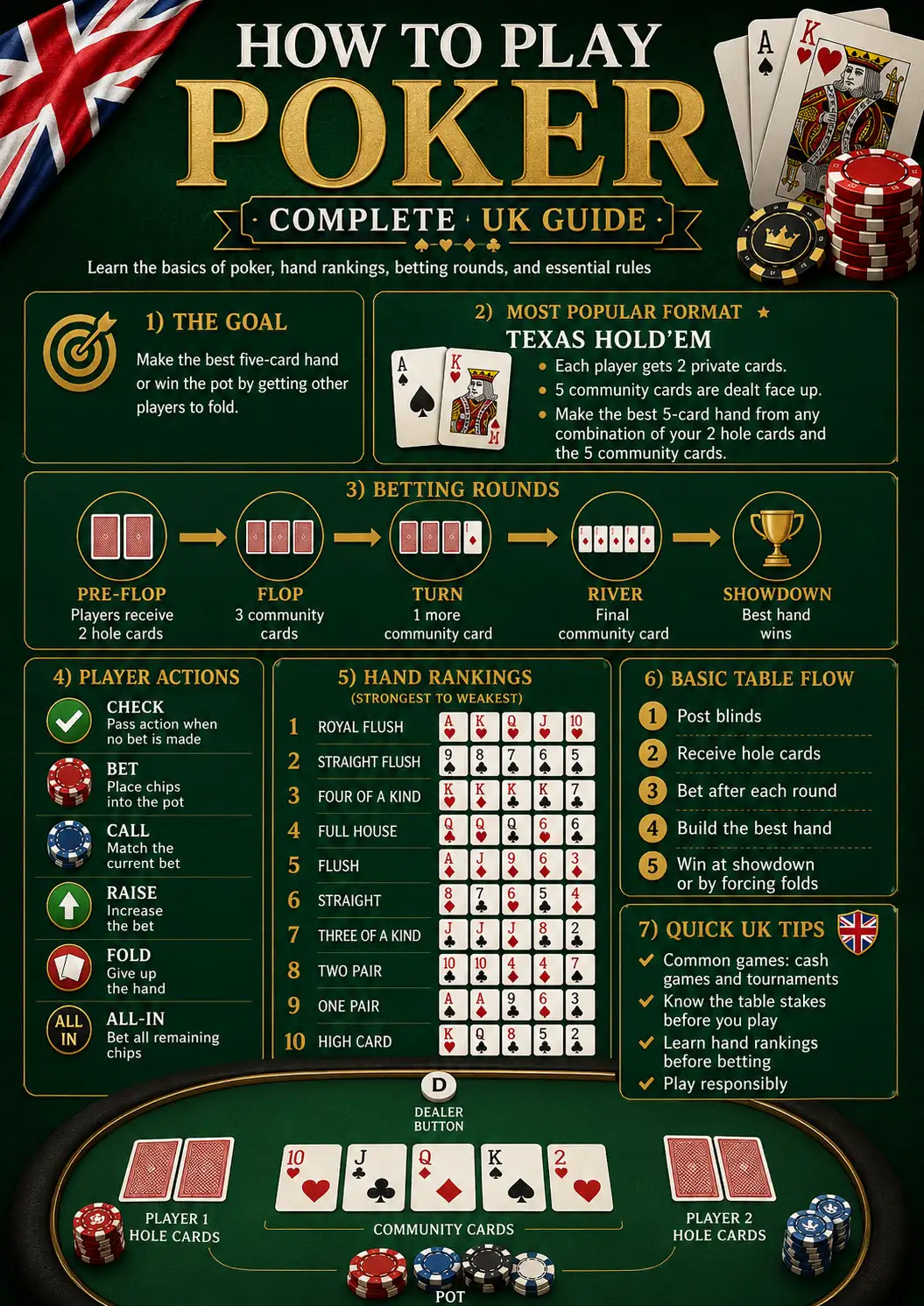
The ultimate goal of poker is simple: win the chips in the middle of the table, known as the pot 💰. You can achieve this in two distinct ways: by showing the best five-card hand at the final showdown, or by betting aggressively enough that all other players fold their cards before the hand ends. Virtually all modern poker games are played with a standard 5252-card deck, and while the exact rules change between variants, the fundamental mechanics remain the same.
To navigate a poker table confidently, you need to understand the core elements that drive the action. Every game relies on forced bets, positional awareness, and structured betting rounds.
Key components of a standard poker game include:
- The dealer button: A plastic disc that moves clockwise after every hand to determine the order of play and ensure fairness.
- The blinds: Forced bets placed by the two players sitting immediately to the left of the dealer button before any cards are dealt.
- The action: A player’s turn to act, where they can choose to fold, check, call, bet, or raise depending on the current situation.
- The showdown: The final phase where remaining players reveal their cards to determine who takes down the pot.
Poker hand rankings
Memorising poker hand rankings is the most crucial step for any beginner 🧠. Without knowing what beats what, you cannot accurately judge the strength of your cards or make profitable betting decisions.
Below is the official hierarchy of poker hands recognised across UK card rooms and online casinos, ranked from the absolute strongest to the weakest.
Rank | Hand Name | Description | Example |
|---|---|---|---|
1 | Royal Flush | The best possible hand, featuring a ten to ace straight all in the exact same suit. | A♠️ K♠️ Q♠️ J♠️ 10♠️ |
2 | Straight Flush | Any five consecutive cards belonging to the same suit. | 9♥️ 8♥️ 7♥️ 6♥️ 5♥️ |
3 | Four of a Kind | Four cards of the same rank, accompanied by one side card. | Q♣️ Q♦️ Q♥️ Q♠️ 4♣️ |
4 | Full House | A combination of three cards of one rank and two cards of another rank. | J♠️ J♥️ J♦️ 8♣️ 8♠️ |
5 | Flush | Any five cards of the same suit, regardless of their numerical sequence. | K♦️ J♦️ 7♦️ 4♦️ 2♦️ |
6 | Straight | Five consecutive cards of mixed suits. | 7♠️ 6♥️ 5♣️ 4♦️ 3♠️ |
7 | Three of a Kind | Three cards of the same rank, alongside two unrelated side cards. | 8♣️ 8♠️ 8♦️ K♥️ 3♣️ |
8 | Two Pair | Two distinct pairs of cards, plus one side card. | 10♥️ 10♠️ 5♣️ 5♦️ A♠️ |
9 | One Pair | A single pair of matching cards and three unrelated side cards. | 9♦️ 9♣️ Q♠️ 7♥️ 2♣️ |
10 | High Card | The weakest hand where no pairs or combinations are made, evaluated by the highest single card. | A♥️ J♣️ 8♠️ 6♦️ 3♥️ |
If two players hold the exact same hand ranking, the winner is determined by the highest card within that combination. If the primary combination is identical, the highest uncoupled side card, known as the kicker, breaks the tie.
The most popular poker variations
While the basic premise of making the best five-card hand remains constant, different poker variants offer completely unique challenges and strategies 🎲. UK players have access to a massive variety of formats, whether playing on a mobile app or sitting at a felt table in a local casino.
The most common poker variations you will encounter include:
- Texas Hold’em: Players receive two private cards and share five community cards; this is the undisputed king of modern poker and the easiest format for beginners to learn.
- Pot-Limit Omaha (PLO): Players are dealt four private cards but must use exactly two of them alongside three community cards, creating a highly volatile and action-packed game.
- Seven-Card Stud: A classic format where players receive a mix of face-up and face-down cards over several betting rounds without any shared community cards.
- Short Deck Hold’em: A modern twist on Texas Hold’em where all cards from two to five are removed from the deck, increasing the probability of hitting premium hands.
How to play Texas Hold’em
Texas Hold’em is the undisputed king of poker formats and the game you are most likely to encounter in UK card rooms and online casinos 👑. Every player receives two private hole cards, followed by five shared community cards dealt face-up in the middle of the table. Your goal is to make the best possible five-card hand using any combination of your hole cards and the community cards.
A standard hand of Texas Hold’em unfolds in five distinct phases. Understanding this sequence is vital for tracking the action and planning your strategy.
- Pre-flop: After the blinds are posted, every player is dealt two private hole cards, and the first betting round begins with the player to the left of the big blind.
- The flop: The dealer places three community cards face-up in the centre of the table, triggering a second betting round starting with the active player closest to the left of the dealer button.
- The turn: A fourth community card is dealt face-up, followed by a third round of betting.
- The river: The fifth and final community card is revealed, leading to the last betting round where players make their final moves.
- The showdown: Remaining players reveal their hole cards, and the highest-ranking five-card poker hand wins the pot.
Betting rules and structure
Understanding your betting options is the key to executing any successful poker strategy 💷. Whenever it is your turn to act, you must assess the strength of your hand and choose one of several actions. If no one has bet before you, you can check (pass the action without putting chips in) or bet (place the first wager into the pot). If someone has already bet, you can fold (throw your cards away), call (match the existing bet), or raise (increase the size of the bet).
How much you are allowed to bet depends entirely on the betting structure of the specific game you are playing. UK poker tournaments and cash games typically fall into three main categories.
Betting Structure | Description | Best Suited For |
|---|---|---|
No-Limit (NL) | Players can bet any amount up to their entire chip stack at any time. | Aggressive players and major tournaments like the World Series of Poker. |
Pot-Limit (PL) | The maximum allowed bet or raise is restricted to the current size of the pot. | Action-heavy games like Omaha where drawing hands are common. |
Fixed-Limit (FL) | Bet and raise sizes are strictly pre-determined and usually capped at a certain number of raises per round. | Beginners looking to minimise risk and limit variance. |
Mastering the rules of raising is especially important in No-Limit games. The general rule is that any raise must be at least double the size of the previous bet or raise. Calculating pot odds and sizing your bets correctly will stop opponents from drawing out on you cheaply.
Basic poker strategies for beginners
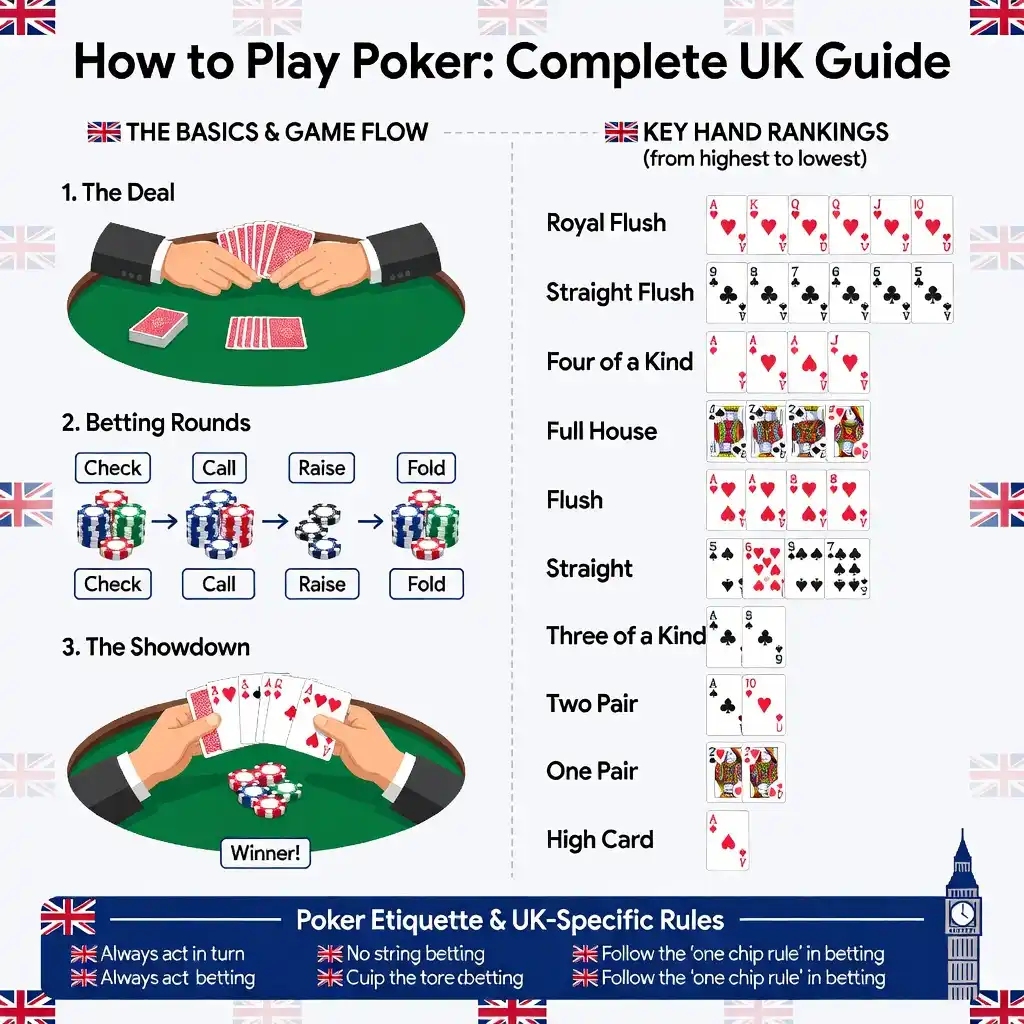
Winning at poker requires more than just waiting for good cards; it demands discipline, observation, and strategic thinking 🎯. Many novice players bleed chips by playing too many hands or letting their emotions dictate their decisions. By adopting a few solid foundational habits, you can immediately elevate your game above the average beginner level.
To build a profitable foundation, focus on these essential beginner strategies:
- Play fewer starting hands: Fold weak or marginal cards pre-flop to avoid getting trapped in difficult situations later in the hand.
- Respect table position: Play more aggressively when you are one of the last to act, as you will have extra information on your opponents’ intentions.
- Manage your bankroll: Never risk more than a small percentage of your total poker funds on a single cash game or tournament buy-in.
- Pay attention to opponents: Watch how other players bet even when you are not in the hand, noting who bluffs often and who only bets with premium cards.
- Avoid emotional tilt: Take a break if you suffer a bad beat or start feeling frustrated, as angry poker is almost always losing poker.
Common poker terms
Stepping into a poker room can sometimes feel like listening to a foreign language 🗣️. Players use specific jargon to describe actions, emotions, and mathematical concepts at the table. Learning this vocabulary helps you follow the action and communicate clearly with the dealer and other players.
Here are the essential poker terms you need to know to sound like a seasoned regular:
- Ante: A small forced bet contributed by all players before a hand begins to stimulate action.
- Bad beat: Losing a hand when you were statistically the heavy favourite to win.
- Bluff: Betting aggressively with a weak hand to force opponents to fold superior cards.
- Muck: Discarding your hand face-down without showing it to the table.
- The nuts: Holding the absolute best possible hand in a given situation, making it unbeatable.
- Tilt: Playing emotionally or recklessly after experiencing a frustrating loss.
Playing poker online vs in-person

The UK boasts a thriving poker scene, offering both world-class brick-and-mortar casinos and strictly regulated online platforms 💻. While the fundamental rules remain identical, the experience of playing live versus online is drastically different. Online poker allows you to play multiple tables simultaneously, track your statistics, and enjoy rapid-fire hands from the comfort of your home.
Live poker, on the other hand, is a deeply social experience where psychology takes centre stage. Sitting face-to-face with opponents at iconic venues like Dusk Till Dawn or The Hippodrome requires extreme patience and sharp observation.
Consider these key differences when choosing where to play your next session:
- Pace of play: Online games process hands automatically, dealing up to three times faster than live human dealers.
- Tells and psychology: Live poker relies heavily on spotting physical tics, whereas online reads depend entirely on betting patterns and timing.
- Accessibility and stakes: Digital platforms offer micro-stakes starting at just a few pence, while live casinos usually require a much higher minimum buy-in.
- Convenience features: Online software automatically calculates pot sizes and clearly displays your chips, removing the need for manual math.
Tips for improving your poker game
Moving from a beginner to a consistently profitable player requires ongoing dedication and study 📈. Poker is a game of skill heavily disguised by short-term luck, meaning your long-term results depend entirely on the quality of your decisions. To gain an edge over your competition, you must actively analyse your play and refine your strategies off the felt.
Implement these proven techniques to continuously elevate your poker skills:
- Review your hand histories: Analyse both winning and losing hands after a session to identify recurring tactical mistakes.
- Study starting hand charts: Memorise mathematically optimal pre-flop ranges so you always know exactly which hands to play from different table positions.
- Discuss strategy with peers: Join UK poker forums, Discord servers, or local study groups to bounce ideas off more experienced players.
- Understand variance: Accept that mathematical downswings happen to everyone, and focus strictly on making correct decisions rather than agonizing over short-term results.
Responsible gambling
Enjoying poker should always be about entertainment, not a desperate way to make money or escape financial difficulties 🛡️. The UK has one of the safest and most strictly regulated gambling markets in the world, overseen by the UK Gambling Commission (UKGC). This ensures that players have access to numerous tools and resources to maintain control over their gaming habits.
Protecting your mental health and bankroll is just as important as learning table strategy. If you ever feel that you are losing control or chasing losses, it is crucial to step away from the table immediately and evaluate your gameplay.
Keep these responsible gambling practices in mind every time you play:
- Set strict deposit and loss limits using the tools provided by your chosen online casino or poker room.
- Never gamble with money that you need for essential living expenses like rent, bills, or groceries.
- Take regular breaks during long sessions to keep your mind fresh and avoid emotional decision-making.
- Utilise free self-exclusion schemes like GAMSTOP if you need a mandatory break from all UK-licensed online gambling sites.
- Reach out to organisations like GamCare or BeGambleAware for free, confidential support if you are struggling.
Summary: How to play poker
Mastering poker is a rewarding journey that blends mathematical probability with deep psychological strategy 🎓. We have covered a lot of ground in this guide, from understanding the core mechanics of betting rounds to memorising the official hand rankings. While the flashing chips and complex terminology might seem overwhelming at first, the foundation of the game relies on a few simple principles.
Whether you are diving into a fast-paced Texas Hold’em cash game or exploring the volatile action of Pot-Limit Omaha, success comes down to patience, positional awareness, and continuous learning. By playing disciplined starting hands, observing your opponents closely, and managing your bankroll wisely, you will quickly elevate your skills above the average beginner. Gather your chips, stay calm, and enjoy the thrill of the UK poker scene!
FAQs
Is it legal to play poker online in the UK?
Yes, playing online poker is completely legal for anyone aged 18 or over in the UK 🇬🇧. You can safely play on any platform that holds a valid licence from the UK Gambling Commission, which guarantees fair play and the security of your funds.
Do I have to pay taxes on my poker winnings in the UK?
No, all gambling winnings, including those from professional poker play, are currently tax-free in the United Kingdom 💷. You get to keep exactly what you win without having to declare it to HMRC as taxable income.
What is the best poker variation for a complete beginner?
Texas Hold’em is widely considered the best starting point for new players. It has straightforward rules, the most abundant educational resources, and is the most readily available game format in both live UK card rooms and online casinos.
Can I play poker for free to practice?
Absolutely! Almost all major UK-licensed online poker sites offer play-money tables where you can learn the software, practice hand rankings, and test strategies without risking a single penny of your own money 🆓.