
Poker Strategy: A Guide to Winning at Poker
In this in-depth UK poker strategy masterclass, we will unpack the essential tactics required to build a consistent win rate 🏆. You will discover how to accurately read the table, manage your bankroll like a seasoned professional, and execute complex, well-timed bluffs that leave your opponents completely bewildered. Of course, applying these high-level skills in a secure and rewarding environment is just as crucial as learning them, which is why testing your newfound knowledge at the Best Poker Sites ensures you extract the absolute maximum value from your grind. Whether you are aiming to dominate soft micro-stakes cash games or take down massive Sunday tournaments, pairing your winning strategy with a top-tier platform will set you up for long-term success.
Understanding the basics
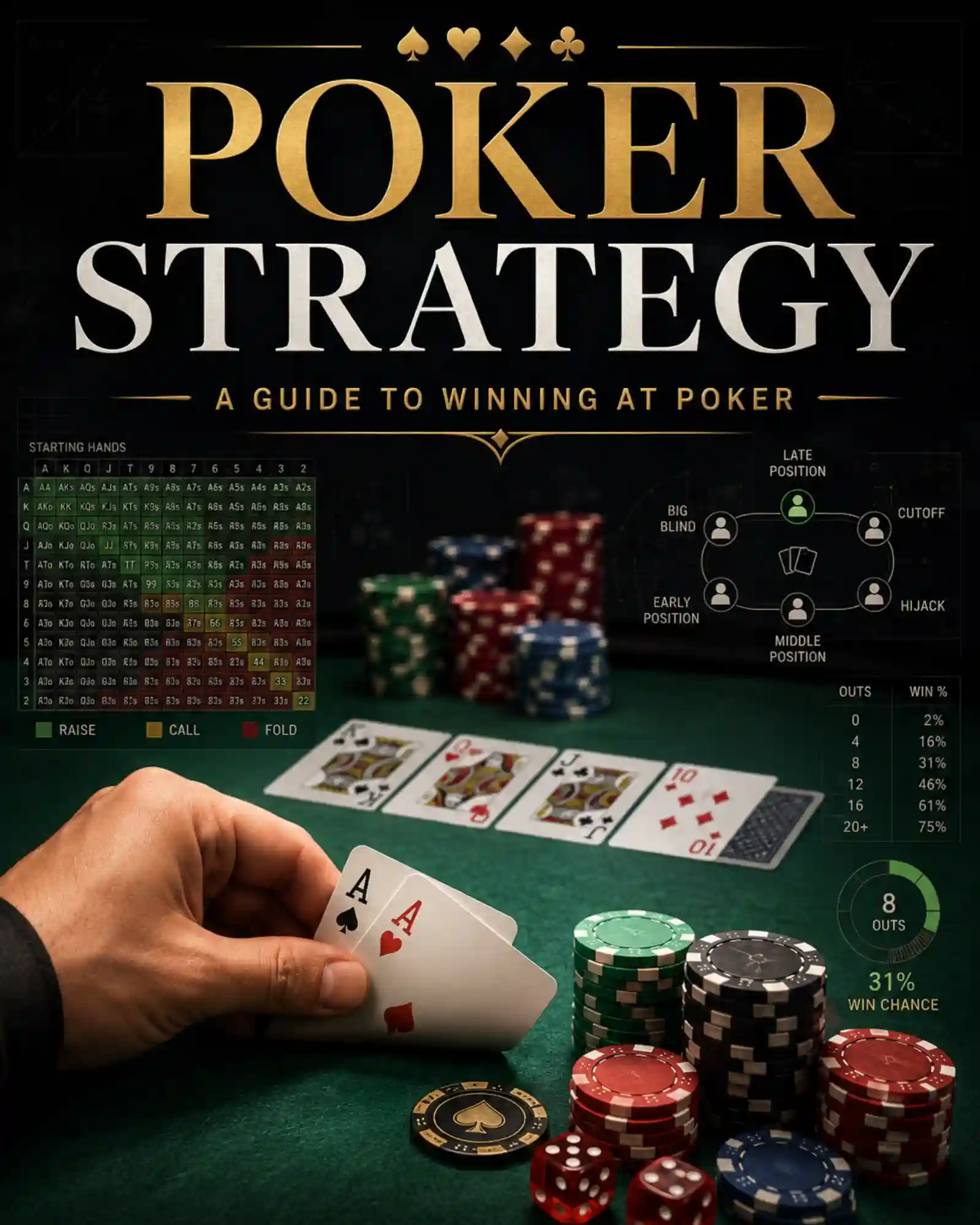
Before diving into advanced psychological warfare, every successful poker player must have an unbreakable grasp of the fundamentals 🧱. At its core, the most popular variant, Texas Hold’em, is about making the best five-card hand using two hole cards and five community cards. However, the true objective is not always to have the best hand, but to make the most profitable decisions over time.
To start your journey, you must memorise standard poker hand rankings. Knowing exactly where your hand stands prevents costly errors at the table.
Here is a quick reference table of poker hands, ranked from highest to lowest:
Rank | Hand Name | Description | Example |
|---|---|---|---|
1 | Royal Flush | A, K, Q, J, 10 of the same suit | A♠️ K♠️ Q♠️ J♠️ 10♠️ |
2 | Straight Flush | Five consecutive cards of the same suit | 5♥️ 6♥️ 7♥️ 8♥️ 9♥️ |
3 | Four of a Kind | Four cards of the exact same rank | 8♣️ 8♦️ 8♥️ 8♠️ 2♣️ |
4 | Full House | Three of a kind combined with a pair | J♠️ J♣️ J♥️ 4♦️ 4♠️ |
5 | Flush | Any five non-consecutive cards of the same suit | 2♦️ 5♦️ 9♦️ J♦️ K♦️ |
6 | Straight | Five consecutive cards of mixed suits | 4♣️ 5♥️ 6♠️ 7♦️ 8♣️ |
7 | Three of a Kind | Three cards of the same rank | 7♥️ 7♠️ 7♣️ A♦️ 2♣️ |
8 | Two Pair | Two distinct pairs in one hand | 10♠️ 10♣️ 5♥️ 5♦️ Q♠️ |
9 | One Pair | Two cards of the same rank | K♥️ K♣️ 8♠️ 4♦️ 3♥️ |
10 | High Card | The highest single card when no other hand is made | A♠️ J♣️ 8♥️ 5♦️ 2♠️ |
Understanding the basic flow of betting rounds—Pre-flop, Flop, Turn, and River—is your next crucial step. Each street offers new information, forcing you to recalculate your odds and adjust your strategy accordingly 🔄.
The best poker sites to test your strategy:

Designed for fast play and easy navigation, West Ace keeps the focus on quick sessions and player rewards.

WINTHERE is built for players who want a smooth, mobile-first experience with a wide mix of slots and live tables—plus regular promos to keep things exciting.


LegionBet is a sleek, mobile-first casino built for fast gameplay, with a strong mix of slots and live tables plus regular promos for everyday players.
Poker position
If there is one golden rule in poker strategy, it is this: position is power 👑. Your physical seat at the poker table in relation to the dealer button dictates when you have to act. Acting last means you possess the maximum amount of information about your opponents’ intentions before making a decision.
Playing in position allows you to control the size of the pot, bluff more effectively, and extract maximum value when holding a premium hand. Conversely, acting first (out of position) puts you at a severe informational disadvantage.
We can break down table positions into four distinct categories:
- Early Position (EP): The players acting immediately after the blinds, often referred to as “Under the Gun” (UTG), who must play extremely tight because the entire table acts after them.
- Middle Position (MP): The seats bridging the gap between early and late position, offering slightly more flexibility but still requiring caution.
- Late Position (LP): The most profitable seats at the table, specifically the Cutoff (CO) and the Button (BTN), allowing you to play a wider range of hands and steal blinds.
- The Blinds: The Small Blind (SB) and Big Blind (BB) are forced bets; you play out of position post-flop, making these the hardest spots to navigate profitably.
Hand selection: Starting hands and table position
Mastering your pre-flop hand selection is the quickest way to plug leaks in your bankroll 💰. Many beginners fall into the trap of playing too many hands, hoping to catch a lucky flop. Professional players, however, meticulously filter their starting hands based on their table position.
As a general rule, the earlier your position, the tighter your hand selection must be. When you are Under the Gun, you should restrict your range to absolute premium holdings. As you move closer to the Button, your requirements can loosen significantly.
Here are the core hand categories you should consider based on your seat:
- Premium hands (AA, KK, QQ, AK suited): These are playable from any position and should almost always be raised pre-flop to build the pot and thin the field.
- Strong broadways and mid-pairs (AQ, AJ, JJ, TT, 99): Excellent hands that perform well in middle to late position, though caution is advised if facing aggressive three-bets from early position players.
- Speculative hands (Suited connectors like 89s, small pocket pairs like 22-66): These hands thrive on implied odds and are best played in late position when you can see a cheap flop or exploit predictable opponents.
Proper hand selection requires discipline 🛑. Folding might feel boring, but patience is the foundation of a winning poker strategy. By merging strict starting hand criteria with an acute awareness of your position, you will immediately gain a mathematical edge over impatient opponents.
Betting strategy
Placing chips into the middle of the table should never be a random act 🎯. Every single bet or raise you make must have a clear, definable purpose. If you cannot explain why you are betting, you are likely better off checking or folding.
In modern poker theory, there are two primary reasons to bet:
- Value betting: Betting with a strong hand to extract chips from a weaker hand that is willing to call.
- Bluffing: Betting with a weak hand to force a better hand to fold, allowing you to win a pot you otherwise would have lost at showdown.
Mastering your bet sizing is equally critical. Sizing your bets correctly puts maximum pressure on your opponents while protecting your own stack. A standard continuation bet (C-bet) on the flop might be between 30% to 50% of the pot, which is often enough to fold out missed hands without risking too much. However, on highly coordinated wet boards where draws are present, you may need to increase your sizing to 66% or even 75% to deny your opponents profitable odds to chase their flushes or straights ⚖️.
Avoid the amateur mistake of sizing your bets based on the strength of your hand. If you bet huge with your strong hands and tiny with your bluffs, observant players in the UK card rooms will quickly decode your strategy and exploit you mercilessly.
Bluffing and semi-bluffing
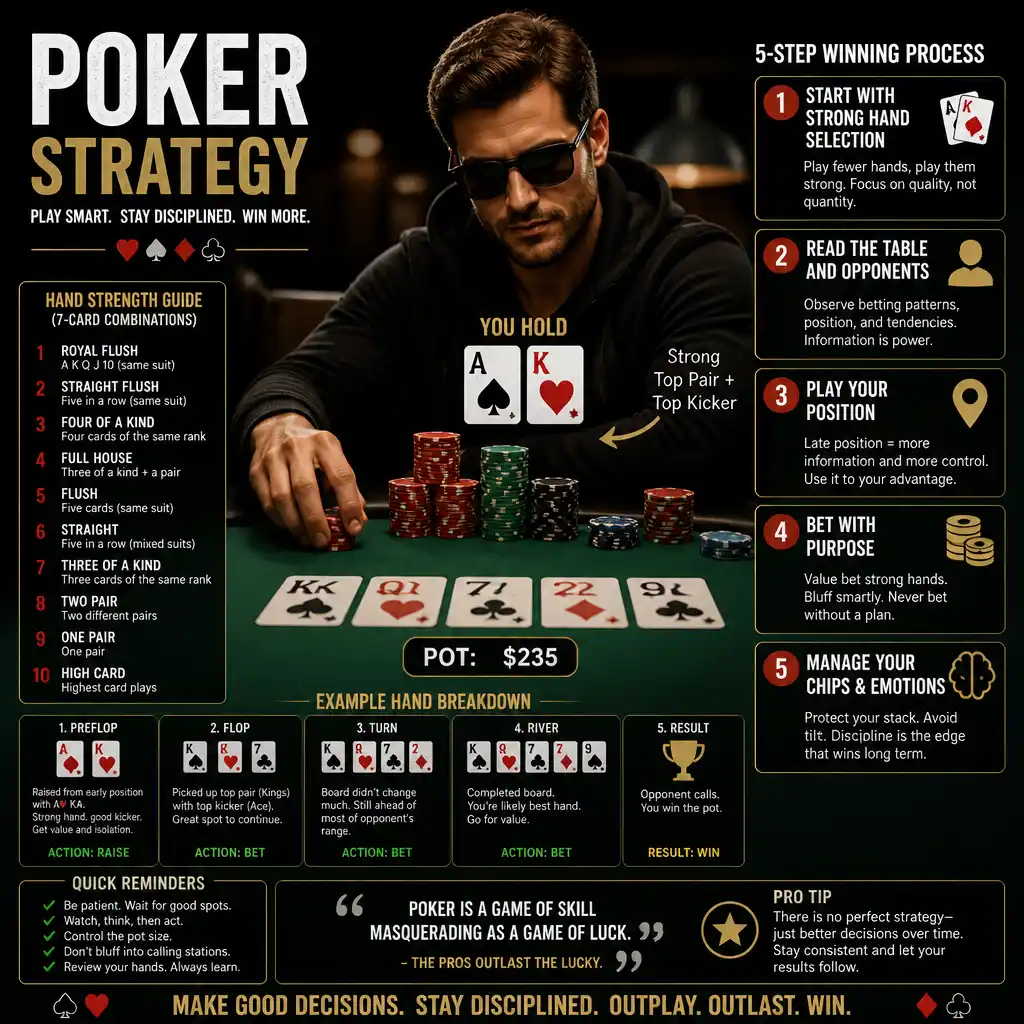
Hollywood movies often portray poker as a game of outrageous, stone-cold bluffs where a player risks their entire net worth on a pair of twos 🎬. In reality, profitable poker relies heavily on a much safer, more calculated concept: the semi-bluff.
A pure bluff involves betting with a hand that has virtually no chance of improving to the winning hand. A semi-bluff, however, means aggressively betting or raising with a hand that is currently not the best, but has massive potential to improve on later streets.
Common scenarios for highly effective semi-bluffs include:
- Holding four cards to a flush (a flush draw).
- Holding an open-ended straight draw (e.g., 8 and 9 on a 7-10-2 board).
- Having a combination of overcards and a backdoor draw.
Semi-bluffing is mathematically superior because it gives you two distinct ways to win the pot ✌️. Firstly, your opponent might fold to your aggression, allowing you to scoop the chips immediately. Secondly, if they call, you still have a strong statistical chance to hit your winning card on the turn or river and extract an enormous payout.
Tells and player tendencies
While physical tells—like a trembling hand, a sudden change in posture, or avoiding eye contact—can be useful in live games, they are often overvalued 🕵️♂️. The most reliable tells in both live and online poker revolve around betting patterns and player tendencies. Figuring out how your opponents approach the game allows you to categorise them and adjust your strategy accordingly.
Here is a breakdown of the four main player archetypes you will encounter:
Player Type | Characteristics | How to Exploit Them |
|---|---|---|
Tight-Aggressive (TAG) | Plays few hands but plays them aggressively. The mark of a strong regular. | Avoid confronting them without premium hands. Steal their blinds when they show weakness. |
Loose-Aggressive (LAG) | Plays many hands aggressively. Constantly applies pressure. | Trap them with strong hands. Let them bluff their chips away into your premium holdings. |
Calling Station | Plays passively and hates folding. Will chase any draw. | Never bluff them. Bet your strong hands relentlessly for maximum value. |
The Nit | Extremely tight, only plays the absolute top tier of starting hands. | Steal their blinds constantly. Fold immediately if they suddenly start raising. |
By closely observing showdowns, even when you are not in the hand, you can build a mental database of your opponents’ habits 🧠. Notice what sizing they use when they are bluffing versus when they have the nuts. In poker, information is just as valuable as the chips in your stack.
Online poker strategy
Transitioning from a physical casino in the UK to the digital felt requires a significant shift in your approach 💻. Online poker moves at lightning speed, dealing up to three times as many hands per hour compared to a live dealer. This increased volume means you will experience the mathematical highs and lows of the game much faster, requiring exceptional emotional control to avoid tilting.
One of the biggest advantages of playing online is the ability to use tracking software and Heads-Up Displays (HUDs), where permitted. These tools overlay statistical data next to your opponents’ avatars, giving you real-time insights into their pre-flop raising frequencies and folding habits. Even without software, you must pay close attention to betting timings and sizing patterns, as these replace physical tells in the virtual arena.
To thrive in the online ecosystem, you should master the following adjustments:
- Start by playing a single table to get comfortable with the interface before gradually multi-tabling.
- Take advantage of colour-coding systems to instantly tag recreational players, aggressive regulars, or passive calling stations.
- Beware of players using automated bet sizing buttons, as a sudden custom bet size often indicates a uniquely strong hand or an elaborate bluff.
- Keep distractions to a minimum because losing focus for even a minute can cost you an entire buy-in against observant online regulars.
Bankroll management

No matter how skilled you become, you cannot outplay mathematics and natural variance 📉. Even top professionals endure brutal losing streaks, which is why strict bankroll management is the absolute cornerstone of a successful poker career. Your bankroll is the total amount of money you have set aside exclusively for playing poker, and it must be entirely separate from your living expenses.
The golden rule is to never risk too much of your total bankroll at any single table or tournament. If you are playing £1/£2 No-Limit Hold’em cash games, a single maximum buy-in might be £200. To play this stake safely without the constant fear of going broke, you need a substantial cushion to absorb the inevitable bad beats. Mathematically, calculating your required funds can be expressed simply as Target Bankroll=Required Buy-ins×Maximum Table Buy-inTarget Bankroll=Required Buy-ins×Maximum Table Buy-in.
Here is a conservative bankroll management guide for different formats:
Poker Format | Minimum Buy-ins Required | When to Move Down Stakes |
|---|---|---|
No-Limit Cash Games | 30 to 40 buy-ins | Drop down if you fall below 25 buy-ins |
Pot-Limit Omaha Cash | 50 to 60 buy-ins | Drop down if you fall below 40 buy-ins |
Sit & Go Tournaments | 50 to 75 buy-ins | Drop down if you fall below 40 buy-ins |
Multi-Table Tournaments | 100+ buy-ins | Drop down if you fall below 75 buy-ins |
Practising disciplined bankroll management removes the emotion from losing 🛡️. When you know a bad beat only cost you 2% of your total poker funds, you can calmly reload your stack and continue making mathematically profitable decisions.
Adapting to different poker variants
While No-Limit Texas Hold’em is undoubtedly the most popular game globally, expanding your repertoire can significantly increase your win rate 🌍. Many recreational players flock to alternative games looking for action, creating highly profitable environments for players who take the time to study the specific strategies of these variants.
Pot-Limit Omaha (PLO) is incredibly popular in European and UK card rooms. In PLO, you are dealt four hole cards instead of two, but you must use exactly two of them alongside three community cards. This drastically inflates the average winning hand strength; while two pair is a monster in Hold’em, it is often a losing hand in PLO. You must adjust by heavily prioritising drawing to the “nuts” (the best possible hand).
Short Deck (Six Plus Hold’em) is another action-packed variant gaining massive traction. All cards from two through five are removed from the deck, which fundamentally alters the mathematics of the game. Because there are fewer cards, you will hit premium hands more often, but flush draws become mathematically harder to complete. In standard Short Deck rules, a flush actually beats a full house, and you must completely recalibrate your starting hand selection to reflect this dynamic shift 🃏.
Common mistakes to avoid in poker
Even seasoned players can fall into bad habits that slowly drain their win rate over time 🛑. Identifying and eliminating these common pitfalls is one of the fastest ways to improve your bottom line and separate yourself from the average recreational punter at a UK card room.
Perhaps the most destructive mistake is playing purely on emotion, commonly known as “going on tilt.” When anger or frustration takes over after a bad beat, players abandon logic, play too many hands, and make aggressive but mathematically disastrous bets. If you feel your pulse racing and your discipline slipping, the most profitable move you can make is to stand up and walk away from the table.
Other frequent leaks to patch in your game include:
- Overplaying premium hands post-flop: A pair of Aces is fantastic pre-flop, but if the board comes down highly coordinated and your opponent faces you with immense aggression, you must find the discipline to fold.
- Limping into pots: Calling the big blind pre-flop instead of raising gives your opponents cheap equity and surrenders the initiative, making it much harder to win the pot post-flop.
- Ignoring stack sizes: A strategy that works with a 100 big blind stack is vastly different from one needed when you only have 15 big blinds. Failing to adapt to effective stack depth will severely punish your bankroll.
Responsible gambling
While poker is undeniably a game of skill where studying and strategy lead to long-term profitability, it is still a form of gambling and must be treated with respect ⚖️. A healthy relationship with poker ensures that it remains an enjoyable and mentally stimulating pursuit rather than a source of financial stress.
Always set strict time and monetary limits before you log onto an online poker site or step into a live casino. Never chase your losses by jumping into higher stakes to win back what you dropped; this is a guaranteed path to ruin. Keep your poker bankroll entirely segregated from the funds you need for rent, bills, and everyday life in the UK.
If you ever feel that your gambling is becoming compulsive or negatively impacting your personal life, it is crucial to seek immediate support. Organisations like GamCare, BeGambleAware, and the UK Gambling Commission provide excellent, confidential resources and self-exclusion tools to help you maintain control 🛡️.
Summary: Poker strategy
Mastering poker is a lifelong journey, but establishing a solid foundation gives you an immediate edge over the vast majority of the playing pool 🏆. The difference between a losing player and a profitable grinder lies in discipline, mathematical awareness, and emotional control.
You must internalise hand rankings and ruthlessly apply positional awareness, folding marginal hands early and attacking from the Button. Every bet you make must serve a distinct purpose—either extracting value from weaker hands or executing mathematically sound semi-bluffs. Finally, you must protect your hard-earned capital through strict bankroll management, ensuring that short-term variance never knocks you out of the game completely.
FAQs
What is the most important skill for a beginner to learn?
Without a doubt, mastering pre-flop hand selection based on position is the most vital skill. Learning to fold poor starting hands keeps you out of difficult, unprofitable post-flop situations.
How do I stop playing predictably?
You must balance your ranges. This means playing your strong hands and your bluffs in a very similar manner. If you only bet big when you have a monster and bet small when you are bluffing, observant opponents will easily exploit you.
Is it better to play cash games or tournaments?
This depends on your schedule and bankroll. Cash games offer flexibility, allowing you to leave whenever you want, and generally feature lower variance. Tournaments require a massive time commitment and have much higher variance, but they offer the chance for a massive, bankroll-altering payday.
How many buy-ins do I need to play online poker safely?
For No-Limit Texas Hold’em cash games, a minimum of 30 to 40 buy-ins is recommended. If you plan to play multi-table tournaments, where variance is much higher, you should maintain a bankroll of at least 100 average buy-ins.